


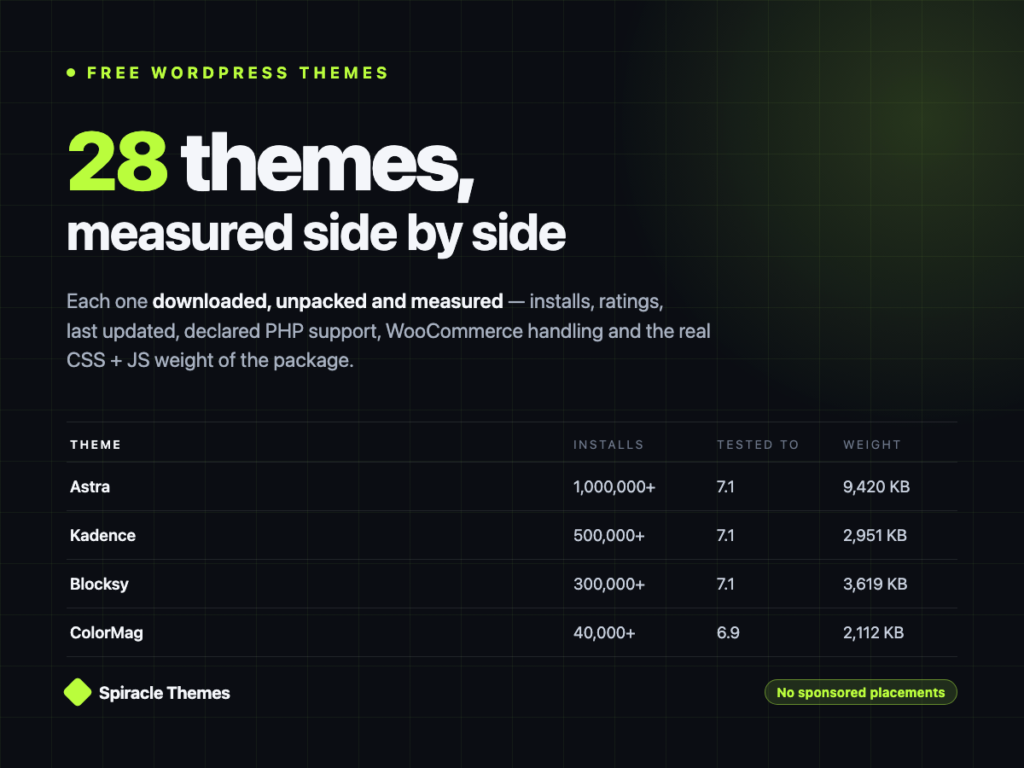
Last verified: 12 November 2026. Every theme in this list was downloaded from the
WordPress.org theme directory on that date, unpacked, and measured. Install counts, ratings and last-updated
dates come from the WordPress.org theme API on the same day. Nothing here is copied from a vendor’s
marketing page. Every figure below is a snapshot of 12 November 2026: install counts move week to week,
ratings accumulate, and a theme that shipped last week may go a year without another update.
The short answer. If you want the safest default, take Astra or
Kadence — the two most-installed themes here that still ship regularly and pass our
weight test. If you want a block theme with the least bloat, Twenty Twenty-Five weighs
4 KB of CSS and no JavaScript at all. If you are building a store, start with
Storefront or Blocksy. If your site is a magazine, newsletter or news
site, ColorMag or News Magazine X will save you weeks of layout work.
If your budget is zero and your tolerance for upsells is low, GeneratePress and
Ashe stay out of your way.
How we tested (and what we could not test)
Most “best free WordPress themes” articles are written from press releases. We did something narrower
and more boring: we measured the packages themselves. For every theme below we recorded:
- Active installs, rating and number of votes — pulled from the WordPress.org theme
API on 12 Nov 2026, not from the theme’s own site. - Last release date and the WordPress version the theme’s own readme
declares it is tested up to. These two numbers together are the best public answer to
“is this theme abandoned?” — and no other roundup we checked publishes them per theme. - Real download weight — we unpacked the theme package and added up every
.cssand.jsfile it ships, uncompressed, plus the size of the .zip. This
is the number that decides whether the word “lightweight” in a theme’s description means anything. - Build type — verified from the package, never from the directory tag:
Block if it shipstemplates/index.html, Hybrid if it ships
theme.jsonbut no block templates (it supports the block editor while its layout controls
stay in the customizer), Classic if it ships neither. - WooCommerce support — verified by a literal
add_theme_support( 'woocommerce' )in the theme’s PHP, not by a tag in the directory.
The honest limitation: package weight is not the same as page weight. A theme that
ships 9 MB of CSS and JavaScript may send a fraction of it to a visitor, depending on which templates and
modules you enable; a 4 KB theme can be made heavy by plugins. We are telling you what is in the
download, because that is measurable, comparable, and reproducible. Nobody in this niche publishes it.
If you want true front-end page weight, measure your own build after installing.
Two things we did not measure, so we are not going to pretend otherwise: we did not run
Lighthouse scores on 28 live demo installs, and we did not subscribe to 28 Pro tiers to audit their
features line by line. Where we describe what a paid tier adds, it is from the vendor’s own free-vs-pro
page, linked.
Every theme, side by side
28 themes, sorted by active installs. Last updated is when the theme’s current version was pushed to the directory. It is not a
release date — it is a maintenance signal, and it is the column to read if you care whether a theme is still
being worked on.
Tested to is the WordPress version the theme’s own readme.txt declares —
not what we think it works with. Weight is every CSS and JS file shipped in
the package, uncompressed. Build is block / hybrid / classic as defined above. Verdict is our
call: Pick (recommended for that job), Solid (fine, nothing special), Niche
(ours, small audience), Skip (see the section at the end).
| Theme | Installs | Rating | Last updated | Tested to | Build | Weight | Verdict |
|---|---|---|---|---|---|---|---|
| Astra | 1,000,000+ | 4.9 (6,557) | 12 Nov 2026 | 7.1 | Hybrid · Woo | 9,420 KB | Pick |
| Hello Elementor | 1,000,000+ | 4.2 (131) | 3 Nov 2026 | 7.1 | Hybrid · Woo | 559 KB | With Elementor |
| Twenty Twenty-Five | 1,000,000+ | 4.0 (14) | 20 May 2026 | 7.0 | Block · — | 4 KB | Pick |
| GeneratePress | 500,000+ | 4.9 (1,428) | 1 Dec 2025 | 6.9 | Classic · Woo | 864 KB | Pick (dev) |
| Kadence | 500,000+ | 4.9 (458) | 6 Nov 2026 | 7.1 | Hybrid · Woo | 2,951 KB | Pick |
| Twenty Twenty-Four | 500,000+ | 3.8 (39) | 19 Aug 2026 | 7.1 | Block · — | 2 KB | Solid |
| OceanWP | 400,000+ | 4.9 (5,720) | 26 Oct 2026 | 7.1 | Classic · Woo | 2,960 KB | Solid |
| Blocksy | 300,000+ | 5.0 (874) | 30 Oct 2026 | 7.1 | Hybrid · Woo | 3,619 KB | Pick (shops) |
| Extendable | 200,000+ | 5.0 (4) | 8 Nov 2026 | 7.1 | Block · — | 240 KB | Solid |
| Neve | 200,000+ | 4.7 (1,284) | 6 Nov 2026 | 7.1 | Classic · Woo | 2,384 KB | Solid |
| Lightning | 100,000+ | 4.8 (12) | 11 Nov 2026 | 6.9 | Hybrid · Woo | 5,747 KB | Solid |
| PopularFX | 100,000+ | 4.6 (115) | 13 Aug 2025 | 6.8.2 | Classic · Woo | 134 KB | Skip |
| Storefront | 90,000+ | 4.5 (155) | 9 Dec 2025 | 6.5 | Classic · Woo | 568 KB | Pick (Woo) |
| Sydney | 80,000+ | 4.9 (795) | 9 Nov 2026 | not stated | Hybrid · Woo | 2,620 KB | Solid |
| Hestia | 70,000+ | 4.8 (563) | 29 Oct 2026 | 5.8.2 | Classic · Woo | 2,887 KB | Solid* |
| Inspiro | 60,000+ | 4.7 (127) | 10 Nov 2026 | 7.1 | Hybrid · Woo | 1,825 KB | Solid (portfolio) |
| Colibri WP | 50,000+ | 4.8 (266) | 28 Oct 2026 | 7.1 | Classic · Woo | 4,488 KB | Skip |
| OnePress | 50,000+ | 4.6 (154) | 6 Nov 2026 | not stated | Hybrid · Woo | 3,295 KB | Solid |
| ColorMag | 40,000+ | 4.9 (1,568) | 2 Nov 2026 | 6.9 | Hybrid · Woo | 2,112 KB | Pick (magazines) |
| Ashe | 30,000+ | 4.9 (304) | 23 Oct 2026 | not stated | Classic · Woo | 558 KB | Pick (blogs) |
| Woostify | 30,000+ | 4.9 (126) | 20 Oct 2026 | 5.2.3 | Classic · Woo | 1,547 KB | Skip |
| Zakra | 30,000+ | 4.9 (600) | 16 Sep 2026 | 7.0 | Hybrid · Woo | 3,087 KB | Solid |
| BlogHash | 10,000+ | 4.7 (13) | 5 Oct 2026 | 7.1 | Classic · Woo | 2,828 KB | Solid |
| Flash | 10,000+ | 4.9 (259) | 1 Oct 2026 | 7.1 | Classic · Woo | 2,320 KB | Solid |
| Mesmerize | 10,000+ | 4.8 (348) | 12 Aug 2026 | 7.1 | Classic · Woo | 2,070 KB | Solid |
| News Magazine X | 8,000+ | 5.0 (30) | 6 Oct 2026 | 7.1.2 | Hybrid · — | 2,087 KB | Pick (news) |
| Own Shop (ours) | 500+ | 5.0 (11) | 25 Mar 2026 | 6.9 | Classic · Woo | 1,443 KB | Niche |
| Shopbar (ours) | 100+ | unrated | 24 Aug 2026 | 7.1 | Classic · Woo | 532 KB | Niche |
As of 12 November 2026. Every install count, rating, vote
count, last-updated date, declared tested-to version and byte weight in this table was read on that date.
Install counts in particular drift from week to week, so read that column for order of magnitude, not to the
last digit.
Disclosure: we build two of the themes above — Own
Shop and Shopbar. They are marked, their install counts and ratings are published
exactly as the directory reports them (including the weak ones), and they are measured with the same ruler as
everything else. If that makes you distrust the list, the table is still true for the other 26.
The best free WordPress themes overall
Astra — 1,000,000+ installs, 4.9 from 6,557 ratings, last updated 12 Nov 2026
Astra is the default answer for a reason: the largest install base in the directory, the largest review
base, releases roughly weekly, and it declares compatibility up to WordPress 7.1. The free theme gives you
layout control, blog layouts, container widths and a clean base that works with the block editor, Elementor
and Beaver Builder. What Pro adds is the part people actually want later: the header and footer builder,
mega menu, and the WooCommerce modules.
The trap is the weight. Astra ships 9,420 KB of CSS and JavaScript in the package —
the heaviest in this list by a factor of two. Almost none of that reaches a visitor, because the theme
loads modules on demand, but it tells you how much machinery is in there. If you install Astra, spend the
twenty minutes in the customizer disabling the modules you do not use. Verdict: pick — the
safest long-term bet for a business site, as long as you prune it.
Kadence — 500,000+ installs, 4.9 from 458 ratings, last updated 6 Nov 2026
Kadence is the best hybrid in this list: it ships theme.json so the block editor behaves,
and it includes a real header/footer builder at no cost, which is unusual — most competitors paywall
exactly that. Updated within the last week, tested to 7.1,
WooCommerce support declared, and 2,951 KB of CSS+JS in the package. The free Kadence Blocks plugin is
generous enough that many sites never need Pro.
The weakness is the upsell surface. Kadence now advertises itself as a full platform —
theme plus hosting, security, backups, memberships — so every admin screen has somewhere to point you.
It is not spammy, but it is persistent. Verdict: pick, especially if you want a block
theme without learning the Site Editor from scratch.
GeneratePress — 500,000+ installs, 4.9 from 1,428 ratings, last updated 1 Dec 2025
GeneratePress free is deliberately minimal: a clean semantic base, sensible hooks, and only 864 KB of
CSS+JS in the package. It is the theme developers install when they want to write their own layout instead
of fighting someone else’s. The paid GP Premium adds the layout controls, hook elements and sections.
The weakness is fresh data, not code quality. The last release was 1 December 2025 and
the readme declares testing only up to WordPress 6.9, while the current release is 7.1. That is eleven
months without a ship date on a theme with half a million installs. It still works; the metadata says the
maintainer is not in a hurry. Verdict: pick for developers, but check the changelog before
you build a client site on it.
Blocksy — 300,000+ installs, 5.0 from 874 ratings, last updated 30 Oct 2026
Blocksy has the highest rating of any theme over 100,000 installs in this list, and the free version is
genuinely complete: header and footer builder, layout controls, WooCommerce integration, and it ships
theme.json so the block editor is styled properly. It is a hybrid, not a block theme — the
Site Editor will not give you its layouts. If you are building a store and want to avoid
Elementor, this is the theme to start from.
The weakness is JavaScript. 3,170 KB of JS in the package is the second-heaviest
script load here, and it is front-end code, not just admin. Pro adds content blocks, hooks and conditional
headers — the things you reach for once the site grows. Verdict: pick for stores.
OceanWP — 400,000+ installs, 4.9 from 5,720 ratings, last updated 26 Oct 2026
OceanWP has more ratings than any other theme in this list — 5,720 of them — and it is the classic
“free theme plus extension ecosystem” model: the theme is free, WooCommerce support is built in, and then
there are dozens of extensions. Tested to 7.1, updated last month, 2,960 KB of CSS+JS.
The weakness is the ecosystem. The free theme is a competent shell; the layouts and
widgets people actually want live in the extensions. That is not a scam, it is just a different deal from
Blocksy or Kadence, where more is free. Verdict: solid — good for agencies that want a
known quantity with a big support forum.
Neve — 200,000+ installs, 4.7 from 1,284 ratings, last updated 6 Nov 2026
Neve is Themeisle’s lightweight classic theme: it works with the block editor and Elementor, loads a
modest 2,384 KB of CSS+JS, and is tested to 7.1. The free version covers the basics well and integrates
with their starter-sites library.
The weakness is where the paywall sits: the header/footer builder grid, WooCommerce
booster features and the advanced layout options are Pro. Verdict: solid — a reasonable
middle option, though Blocksy gives you more free.
Best free themes for blogs, magazines and news sites
ColorMag — 40,000+ installs, 4.9 from 1,568 ratings, last updated 2 Nov 2026
ColorMag is the magazine theme with the most review mass here: 1,568 ratings at 4.9. It ships magazine
layouts, a news-style homepage, widget-ready columns and block patterns that get you to a
publication-looking site in an afternoon. Two caveats from the measurement: it declares testing only to
WordPress 6.9, and the package is 8,574 KB — the second-largest .zip in the list. Verdict:
pick for magazines.
News Magazine X — 8,000+ installs, 5.0 from 30 ratings, last updated 6 Oct 2026
The highest rating in this entire list (5.0), purpose-built for news, tested to 7.1.2, and relatively
lean at 2,087 KB of CSS+JS. The catch is scale: 8,000 installs and 30 ratings means a small user base and a
thinner support community than ColorMag. Verdict: pick for news if you want a
newsroom-style layout without a page builder.
Ashe — 30,000+ installs, 4.9 from 304 ratings, last updated 23 Oct 2026
Ashe is the quiet one: a blog-first theme, 558 KB of CSS+JS in the package (the lightest classic theme
here), tested to WordPress 7.1.3, no page-builder dependency, no upsell theatre. If your site is written
words and images, this does the job and stays out of the way. Verdict: pick for blogs.
Flash — 10,000+ installs, 4.9 from 259 ratings, last updated 1 Oct 2026
ThemeGrill’s second entry: a portfolio/blog hybrid with a left-sidebar layout and clean typography,
tested to 7.1, 2,320 KB of CSS+JS. Fewer installs than ColorMag but the same maintenance discipline.
Verdict: solid.
BlogHash — 10,000+ installs, 4.7 from 13 ratings, last updated 5 Oct 2026
A clean, modern blog theme tested to 7.1 with a decent free feature set. The rating count (13) is too
small to mean much either way, and 2,828 KB of CSS+JS is heavier than Ashe for a similar job.
Verdict: solid, but Ashe is the better-value pick in this category.
Best free themes for stores (WooCommerce)
Storefront — 90,000+ installs, 4.5 from 155 ratings, last updated 9 Dec 2025
Storefront is WooCommerce’s own theme, maintained by Automattic. It does one job: give Woo blocks and
templates a neutral, correct foundation. 568 KB of CSS+JS — the lightest of the store-capable themes here
— and no design opinions to undo. Two caveats: the last release was December 2025, and the readme declares
testing only to WordPress 6.5, the oldest declaration in this list. Verdict: pick for
WooCommerce if you plan to style it yourself; the stale metadata is a real signal to watch.
Blocksy — see above
Listed again because it is the better choice if you want a store design out of the box: header
and footer builder, WooCommerce layout controls and theme.json support, all free. Trade-off: 3,619 KB of
CSS+JS versus Storefront’s 568 KB.
Zakra — 30,000+ installs, 4.9 from 600 ratings, last updated 16 Sep 2026
ThemeGrill’s multipurpose hybrid theme with solid WooCommerce support and 600 ratings at 4.9. Tested to
7.0, 3,087 KB of CSS+JS, and the .zip is 7,888 KB — big, but this is a theme with a lot of demo layouts
inside. Verdict: solid for a small shop that wants starter layouts.
Own Shop (ours) — 500+ installs, 5.0 from 11 ratings, last updated 25 Mar 2026
One of ours, and the one we would put forward on merit: a WooCommerce-first classic theme with shop
layouts, product grids and cart/checkout styling, 1,443 KB of CSS+JS, tested to 6.9. It also has the
strongest review data of anything we build — 11 ratings at 5.0 — which on a 500-install theme is a real
signal rather than a hopeful one.
The weakness is cadence: version 1.5.1 shipped 25 March 2026 and its readme declares testing
to WordPress 6.9, so it trails the current 7.1. If you want a shop theme with a maintained support desk
behind it, use Storefront or Blocksy; if you want a lighter WooCommerce theme with no page builder, this is
the one we build. Verdict: niche pick.
Shopbar (ours) — 100+ installs, unrated, last updated 24 Aug 2026
Also ours, and the second-lightest package here that declares WooCommerce support: 533 KB of CSS+JS in a
1,114 KB package, tested to 7.1 with a PHP 7.4 floor — the most current metadata of our two themes in this
list. Only PopularFX ships less, and it is in our skip list for unrelated reasons. The layout is a slim
bar-style header with cart and search, then product-first content. It has no ratings and 100 installs, so
there is no social proof to lean on and we are not going to pretend otherwise.
Verdict: niche pick.
Two more themes can run a small shop without being store themes first: Zakra, and Kadence above. And
then there are our two, which are store themes — they are listed last in this section with their
real numbers, including the ones that flatter us least.
Best free themes for service businesses, local practices and one-pagers
Hestia — 70,000+ installs, 4.8 from 563 ratings, last updated 29 Oct 2026
Hestia is the one-page business theme from Themeisle: a hero, three service boxes, a testimonial block,
a contact section, and a shop page if you turn it on. 563 ratings at 4.8 is real review mass, WooCommerce
is declared, and it shipped at the end of October 2026 — so the theme is maintained.
The catch is in the metadata, not the code. Its readme.txt declares
compatibility only up to WordPress 5.8.2 — a 2021 release — while the theme itself ships
new versions in 2026. That gap almost certainly means the readme was never updated rather than the theme
being untested, but you cannot tell which from the outside, and neither can we. It is also a classic
(customizer) theme at 2,887 KB of CSS+JS, so it is not the lean option.
Verdict: solid, with a caveat you should be aware of before you put a client on it.
OnePress — 50,000+ installs, 4.6 from 154 ratings, last updated 6 Nov 2026
Cross-listed from the block-and-hybrid section because it is the other sensible one-pager: a front page built
for a headline, a call to action and three features, then a normal blog underneath. If you are launching a
consultancy, a clinic or a trade business and you do not want a page builder, Hestia and OnePress are the
two shortest paths to a finished site. OnePress is the block-editor option; Hestia is the customizer
option.
How to pick in about sixty seconds
- Do you need a store?
Start with Storefront if you will style it yourself, Blocksy if you will not. If you would rather start from a theme that exists for WooCommerce and nothing else, that is what our own two entries — Own Shop and Shopbar — are for. They are marked (ours) in the table and measured with the same ruler. - Are you publishing articles daily?
ColorMag or News Magazine X. Weekly or less: Ashe, Flash or Twenty Twenty-Five. - Do you want the Site Editor?
Only three themes here are true block themes: Twenty Twenty-Five (4 KB of CSS, nothing else), Twenty Twenty-Four and Extendable. If you also want a visual header builder, pick a hybrid instead — Kadence or Blocksy — and accept the customizer. - Are you a developer who wants a base, not a product?
GeneratePress (its last update was December 2025) or Twenty Twenty-Five. - Is it a client site you will maintain for years?
Pick on update cadence first: anything that shipped within the last 60 days, and check that again next year. - Do you have zero tolerance for upsells?
Ashe, Twenty Twenty-Five, Storefront, GeneratePress.
Block themes, hybrid themes, and the difference that costs people weeks
This is the most confused label in the free-theme market, so here is the test we actually ran. A theme is
a block theme only if it ships templates/index.html — that file is what hands
layout control to the Site Editor. A hybrid ships theme.json, so it styles the
block editor properly and can be overridden by a Site Editor template, but its own layout controls still
live in the customizer. Everything else is classic.
In this list, by that measurement: 3 block themes, 11 hybrid, 14 classic. And the
counts matter more than the labels, because the three true block themes are the three leanest packages
here — 4 KB, 2 KB and 240 KB of CSS+JS — while none of them ships a header builder, a WooCommerce layout
or demo content. If you want those, you want a hybrid: Kadence, Blocksy and Astra all ship
theme.json and a visual header builder, and they are 2,951 KB, 3,619 KB and 9,420 KB
respectively. That is the actual trade.
Twenty Twenty-Five — 1,000,000+ installs, 4.0 from 14 ratings, last updated 20 May 2026
The default theme, and the measurement is ridiculous in the best way: 4 KB of CSS and zero
JavaScript in the package. It is a set of style variations, patterns and typography presets, with
no framework to fight. Tested to 7.0. If you want to build a site that loads nothing it does not need,
start here and add only the blocks you use. Verdict: pick for lean sites.
Twenty Twenty-Four — 500,000+ installs, 3.8 from 39 ratings, last updated 19 Aug 2026
2 KB of CSS, no JavaScript, tested to 7.1. Twenty Twenty-Four is the more opinionated of the two
defaults — better for business and portfolio layouts, with more polished pattern sets. The 3.8 rating is
mostly people annoyed that it is a block theme at all. Verdict: solid.
Extendable — 200,000+ installs, 5.0 from 4 ratings, last updated 8 Nov 2026
A deliberately blank block theme from Extendify: 240 KB of CSS+JS, tested to 7.1, no demo content, no
opinions. It pairs with their pattern library and site-creation flow. With only 4 ratings the score means
nothing yet, but the package is genuinely minimal. Verdict: solid if you want a blank
canvas rather than a design.
Now the hybrids that get marketed as block themes
Both of these ship theme.json, so their block-editor styling is real. Neither ships block
templates, so the Site Editor will not let you rebuild their headers and archives. If a theme page tells you
it is “block theme ready”, this is usually what that means.
Sydney — 80,000+ installs, 4.9 from 795 ratings, last updated 9 Nov 2026
Sydney ships theme.json and an unusually large pattern library, but no block templates —
so it is a hybrid, and its layout options sit in the customizer despite what the marketing implies. 795
ratings at 4.9 is
real review mass, WooCommerce is declared, and it was updated this month. The costs: 2,620 KB of CSS+JS
and a 7,831 KB package, and the readme does not state a tested-up-to version at all.
Verdict: solid — popular for good reasons, but heavier than its reputation.
The other hybrid worth knowing here is OnePress — the one-page business
layout, covered in the service-business section above.
Best minimal and developer themes
Hello Elementor — 1,000,000+ installs, 4.2 from 131 ratings, last updated 3 Nov 2026
The lightest way to run Elementor: 559 KB of CSS+JS, tested to 7.1, no styling of its own. The 4.2
rating is misleading — people rate it low because it looks like nothing, which is the point. If you do not
use Elementor, there is no reason to install it. Verdict: only with Elementor.
Lightning — 100,000+ installs, 4.8 from 12 ratings, last updated 11 Nov 2026
A Japanese-origin hybrid theme from Vektor, updated yesterday, tested to 6.9, WooCommerce declared. It
is heavy at 5,747 KB of CSS+JS, because it ships a full set of components rather
than a blank canvas. Excellent if you are building in Japanese; overkill otherwise.
Verdict: solid for that use case.
Inspiro — 60,000+ installs, 4.7 from 127 ratings, last updated 10 Nov 2026
WPZOOM’s hybrid theme aimed at photographers and creatives: full-screen video headers, portfolio
layouts, tested to 7.1, 1,825 KB of CSS+JS. Note that WPZOOM’s own roundup lists two of its own themes as
the top picks in this category; we are counting installs instead. Verdict: solid for
portfolios.
Mesmerize — 10,000+ installs, 4.8 from 348 ratings, last updated 12 Aug 2026
A classic one-page business theme with a drag-and-drop front page, 348 ratings at 4.8, last updated in
August. 2,070 KB of CSS+JS. The caveat is the stated PHP floor of 5.6, which is end-of-life — the theme
will run, but its requirements metadata has not kept up with 2026.
Verdict: solid with that caveat.
Three themes we stopped recommending, and the exact reason
Every other roundup in this niche recommends 20-30 themes and finds nothing wrong with any of them. That
is not how software works. These three are still installed on tens of thousands of sites and still
available, but the measurement says do not start a new site on them today:
- Woostify (30,000+ installs) — its readme declares testing only up to
WordPress 5.2.3 and a PHP 5.6 floor. It was last updated in October 2026,
so the theme is alive; the compatibility metadata is six years behind. On a modern host with PHP 8.2+
that is an unknown amount of risk you do not need to take. - Colibri WP (50,000+ installs) — 4,488 KB of CSS+JS, a PHP 5.6 floor, and the theme
is built around its own drag-and-drop builder. Your content ends up shaped by that builder, which is the
hardest kind of lock-in to migrate off later. - PopularFX (100,000+ installs) — 134 KB of CSS+JS looks great until you learn the
design comes from the PageLayer plugin, which the theme is effectively a wrapper for. Last release
August 2025, declared testing to 6.8.2. It is a plugin with a theme attached, not a theme.
What “free” actually gets you
The single question every free-theme buyer asks, and the one vendors answer least clearly. Across the
28 themes here the pattern is consistent:
- Free usually includes: the base layout, typography controls, colours, logo, menus,
blog/archive layouts, and — in the hybrid and block themes —theme.json, patterns and
block-editor styling. - Pro usually unlocks: header/footer builders (except Kadence, where it is free),
hooks and custom-code areas, conditional layouts, extra WooCommerce modules, mega menus, and premium
starter templates. - What free almost never includes: support. Check before you build — several of these
themes route free users to a community forum only. - What “free” does guarantee: GPL licensing, so you can fork it, and availability from
the WordPress.org directory, so a broken update can be rolled back or the theme replaced without a
licence negotiation.
Frequently asked questions
Are free WordPress themes safe to use?
From the WordPress.org directory, yes — every theme there is reviewed against the theme guidelines, must
be GPL, and cannot contain sponsored links or hidden admin code. The risk is not malware, it is
abandonment: a theme that stops shipping updates becomes a compatibility problem. That is exactly
why every row above carries a last-release date and a tested-up-to version. Anything from a random site
offering “nulled” premium themes is a different answer: no.
Do free themes get updates?
The good ones do, on a rhythm. In this list Astra shipped on 12 November 2026, Kadence on 6 November,
Blocksy on 30 October. Two did not ship in over a year: GeneratePress (1 December 2025) and Storefront
(9 December 2025). Updates arrive through wp-admin like any other theme, and the directory will show you
the changelog.
Are free themes slower than premium ones?
Not inherently — our measurements show the opposite is often true. Twenty Twenty-Five ships 4 KB of CSS
and no JavaScript; Astra, a premium-backed theme, ships 9,420 KB in the package. Speed comes from what the
theme loads on a page, not from what it costs. The practical test is your own: install it, run PageSpeed
Insights, then decide.
Can I use a free theme for a business website?
Yes, and most small business sites should. The limitations that matter at business scale are support
response time and the header/footer builder sitting behind the paywall — not the licence. If a client site
needs a custom header, budget for the Pro tier or pick Kadence, where that is free.
What is the catch with free themes?
Three catches, in order of how often they bite: the paid tier owns the features you will want in month
six; free support is usually a forum, not a ticket; and if the maintainer loses interest, you inherit the
maintenance. All three are visible before you install — that is what the last-release and tested-to columns
above are for.
Which is the best free WordPress theme in 2026?
For most sites: Astra, if you will prune its modules; Kadence, if you want a hybrid theme with a free
header builder; Twenty Twenty-Five, if you want the smallest possible page; Blocksy, if you are selling
something. There is no single winner, and any article that names one without showing you the data is
guessing.
About this page
Data pulled from the WordPress.org theme API and from the theme packages themselves on
12 November 2026, against WordPress 7.1. Install counts are rounded as the directory
reports them. Ratings are shown out of 5 with the number of votes in brackets, because a 5.0 from 4 votes
and a 4.9 from 6,557 votes are not the same claim.
What changed in this update: first publication of the measured dataset — install counts,
release dates, declared tested-up-to versions, package weight and WooCommerce verification for all 28
themes. Three themes moved to “skip for now” on the strength of their compatibility metadata. If a theme
ships a new release, this page gets re-measured; the date at the top is the date of the last measurement,
not the date of the last edit.