


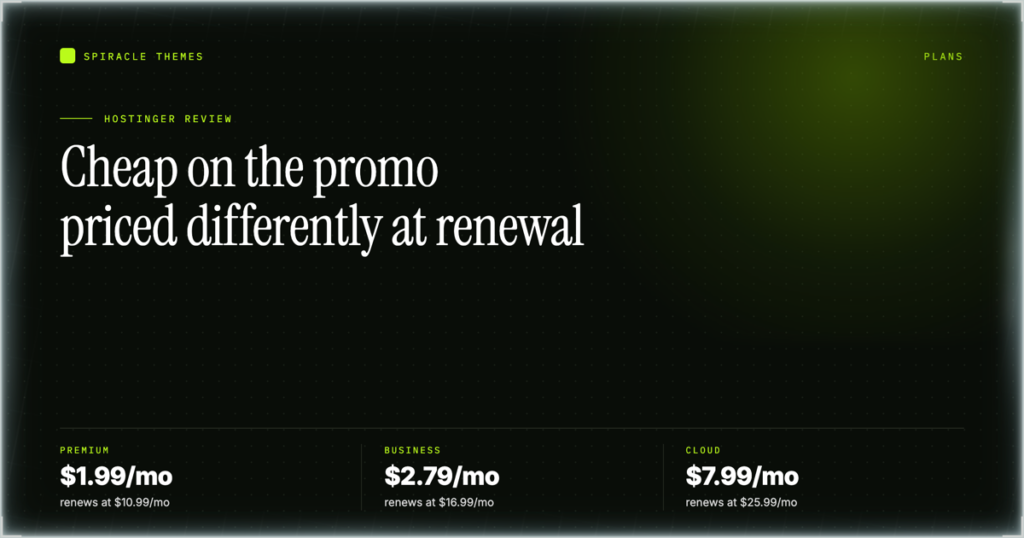
Hostinger’s three shared plans cost $1.99, $2.79 and $7.99 per month on a 48-month term, and the first of those works out to $95.52 up front for the whole term, including a free domain for one year and a 30-day money-back guarantee. It fits a first website, a small client portfolio or a blog that has to start on a fixed budget, and it does not fit anyone who wants a managed server or expects the host to administer the stack for them. The assessment below rests on the published plan data checked 10 November 2026 rather than on a test install of our own.
Hostinger’s shared plans and what they cost
The prices below were on Hostinger’s pricing page on 10 November 2026 and reflect a Black Friday promotion on the 48-month term. The promo price is what you pay today; the renewal price is what the same plan costs when the term ends, so any honest comparison reads both columns.
| Plan | Promo price | Up front, 48 months | Renews at | Websites | Storage | Backups |
|---|---|---|---|---|---|---|
| Premium | $1.99/mo (85% off $12.99) | $95.52 | $10.99/mo | 3 | 20 GB SSD | Weekly |
| Business (shown as “Unlimited”) | $2.79/mo (85% off $18.99) | $133.92 | $16.99/mo | Unlimited | 50 GB NVMe | Daily, with easy restore |
| Cloud Startup | $7.99/mo (71% off $27.99) | $383.52 | $25.99/mo | Unlimited | 100 GB NVMe | Daily and on-demand |
The distance between the two price columns is the most important thing to understand about Hostinger’s pricing. Premium roughly quintuples at renewal, Business roughly sextuples, Cloud Startup roughly triples. That does not make the plans bad value, but it does mean a $95.52 decision and a four-year commitment are the same purchase, and the larger number is the one to show a client before signing off. For a project with an end date, the long term is the wrong instrument.
Check the live pricing before you commit: compare the current Hostinger hosting plans — Premium is $1.99/mo on a 48-month term ($95.52 up front, renews at $10.99/mo), and the 30-day money-back guarantee covers the purchase if the panel does not suit you.
What each tier actually gives you
Premium carries 3 websites, 20 GB of SSD storage, weekly backups, a CDN, ecommerce available through the plan, priority 24/7 support, the AI Builder, WordPress, AI coding tools and custom code, plus 2 mailboxes per website free for one year. The two details that decide most purchases are storage type and backup frequency: Premium is SSD, not NVMe, and weekly means a Friday mistake can cost you six days of orders.
Business, labelled “Unlimited” on the plan card, removes the website cap and moves to 50 GB NVMe with daily backups and an easy restore path. It adds unlimited mailboxes per website free for one year, free AI email marketing for one year up to 100 subscribers, and 1,000 AI credits during the promotion instead of 250. On the published data this is where the price-to-capability ratio stops being a compromise: the daily backup and the NVMe storage are the two things you would otherwise pay a more expensive host to get.
Cloud Startup keeps unlimited websites and mailboxes, raises storage to 100 GB NVMe, keeps daily backups and adds on-demand snapshots, and includes 2,000 AI credits. Hostinger positions it for agencies and high-traffic projects with “dedicated power”, and it is the tier that carries the free 24-hour plan boost on cloud. For a single small site it is overbought; for eight client sites on one account the per-site maths changes quickly.
The performance claims Hostinger makes
Hostinger’s plan pages state NVMe storage, LiteSpeed servers, a built-in CDN, Object Cache, a global data center network and free SSL. Business and Cloud Startup cards also claim you can “handle traffic spikes with unlimited bandwidth”. Those are the vendor’s descriptions of the platform, not measurements, and nothing on the plan page quantifies any of them. We have not run a load test against these plans, so this review makes no claim about response times.
What can be said from the published data is narrower and more useful: storage type is listed per tier, so you can see where NVMe starts; the CDN is included on all three plans rather than sold separately; and SSL comes with the plan rather than as an add-on. If a measured figure matters to your decision, ask support for it in writing before you pay. A host that will not put a number in an email is telling you something.
hPanel, the AI builder and email
hPanel lives at hpanel.hostinger.com and administers everything in this review: websites, domains, email, billing. The DNS zone editor sits under Domains, then DNS, then the DNS records tab, with seven tabs across the top covering records, child nameservers, redirects, DNSSEC, history, subdomains and SSL. For a non-technical buyer it is the strongest part of the offer, because work that normally goes to a developer, pointing a domain or adding a TXT record, becomes a form with a save button.
The AI Builder is included on all three shared plans with credits: 500 on Premium during the promotion, 1,000 on Business, 2,000 on Cloud Startup. One limitation matters more than the credit count. Sites built on a temporary AI Builder domain do not show nameservers, because that DNS cannot be managed directly, so the site stays temporary until you connect a real domain you own. That makes the builder a drafting tool: connecting the domain is still a separate step you complete yourself.
Email is included rather than bolted on. Mailboxes are free for the first year at the per-plan limits above, webmail runs at mail.hostinger.com, and the connection values are imap.hostinger.com on port 993 with SSL for incoming and smtp.hostinger.com on port 465 with SSL, or 587 with STARTTLS, for outgoing, as listed in Hostinger’s email configuration article. The username is the full email address and the password is the mailbox password, not your Hostinger account password, which is the mistake behind most failed setups.
Support and the 30-day guarantee, including what it excludes
Hostinger states 24/7 support on its site and lists priority 24/7 support on all three shared plans, so the difference between tiers is queue position rather than whether help exists. Nothing published quantifies response times, and this review will not invent one. What you can judge in advance is scope: support helps with the panel, the plan and the platform, and will not write your theme, fix a plugin conflict or administer a VPS for you.
The 30-day money-back guarantee applies to most hosting and email services paid by any method other than cryptocurrency, counted from the original purchase date. It explicitly does not cover domain renewals, completed domain transfers, redemption fees, domain privacy protection, Google Workspace Email, the Hostinger Email Storage add-on, VPS Control Panel licences, upgrades of KVM VPS or Game Panel plans, Paid Boost for Cloud Hosting, Hostinger GPU, AI and LLM credits of any type, the first payment after a free trial, most country-code TLD registrations, or services suspended for abuse. Requesting a refund also cancels the service immediately and deletes files, databases and email, so the backup comes first. The step-by-step refund walkthrough covers the click path and the timing in full.
When the VPS line is the better buy
KVM 1 is $6.49/mo on a 24-month term, renewing at $11.99/mo, and gives 1 vCPU, 4 GB RAM, 50 GB NVMe and 4 TB of bandwidth, with free weekly backups and an AI web terminal. For roughly three times the Premium promo price you get a machine rather than a plan. What you do not get is anyone to run it: Hostinger VPS is unmanaged, which means installing and updating the OS and applications, creating the DNS zone, setting up a mail server and installing SSL are all yours. The KVM plan breakdown covers the specs and the setup flow.
The honest rule is that a VPS is cheaper only if your time is free or your skills are already there. A WordPress site on Premium needs no administration; the same site on KVM 1 needs an operating system, a web server, PHP, a database, a firewall, TLS renewal and a backup routine you have tested. Move up when you need root access or a specific stack, not because the RAM figure looks better. Existing shared-hosting accounts can also upgrade rather than buy separately, which is the sane path if you are already hosted.
Choose Hostinger if, skip it if
| Choose Hostinger if you… | Look elsewhere if you… |
|---|---|
| Need one to three WordPress sites online for under $100 up front | Need a host that administers the server, patches it and takes responsibility for the stack |
| Want DNS, email and hosting billed in one panel with no add-on pricing | Need daily backups at the entry price, not the second tier |
| Are comfortable that the renewal price is 5 to 6 times the promo price | Cannot commit to a 48-month term and will not pay the shorter-term rate |
| Will use the AI Builder or WordPress and do not need root access | Need root access and will not administer an unmanaged server yourself |
| Want a documented 30-day exit that you can read before buying | Are buying a country-code domain, crypto payment or VPS upgrade and expect it covered |
Start with the entry plan and upgrade later: see the Hostinger shared hosting options — Premium covers 3 websites with 20 GB SSD from $1.99/mo on a 48-month term, which is enough to find out whether the panel suits how you work.
Frequently asked questions
Is Hostinger good for WordPress?
On the published plan data, yes for a small site. WordPress is listed on Premium alongside the AI Builder and custom code, the panel handles the database and SSL side, and the entry price is low enough that a first blog is not a financial commitment. The limits to accept are weekly backups and 20 GB of SSD on the cheapest tier; if either is a problem, Business is the plan that fixes both.
How much does Hostinger cost in the first year?
$95.52 for Premium on the 48-month term, $133.92 for Business and $383.52 for Cloud Startup, all paid up front for the full term rather than annually. Those figures include a free domain for one year. At renewal the same plans cost $10.99, $16.99 and $25.99 per month respectively, so the four-year outlay is considerably higher than the advertised monthly rate suggests.
Does the price stay at $1.99 per month?
No. $1.99/mo is the promotional rate for the initial 48-month term. Premium renews at $10.99/mo, Business at $16.99/mo and Cloud Startup at $25.99/mo. Any budget built on the promo number needs a second line for renewal, and that line is where most of the real cost of a long-term Hostinger purchase sits.
Can I get a refund if I do not like it?
Yes within 30 days of the original purchase date, for most hosting and email services, as long as you did not pay in cryptocurrency. Domain renewals, completed transfers, VPS upgrades, AI credits and several add-ons are excluded. The refund also cancels the service immediately and deletes the data, so export anything you need before you submit the request.
Is Hostinger managed or unmanaged hosting?
The shared plans behave like managed hosting: you get a panel, WordPress, SSL and email without touching a server. The VPS line is explicitly unmanaged, with OS and application updates, the DNS zone, the mail server and SSL all handled by you. That split is the main reason a cheap VPS is not automatically a cheaper replacement for Premium.
If you are still deciding whether you need hosting at all, the explainer on what web hosting actually is walks through the concepts without the pricing pressure. Otherwise, pick the tier that matches your site count and backup tolerance, and treat the renewal price as the real price.