
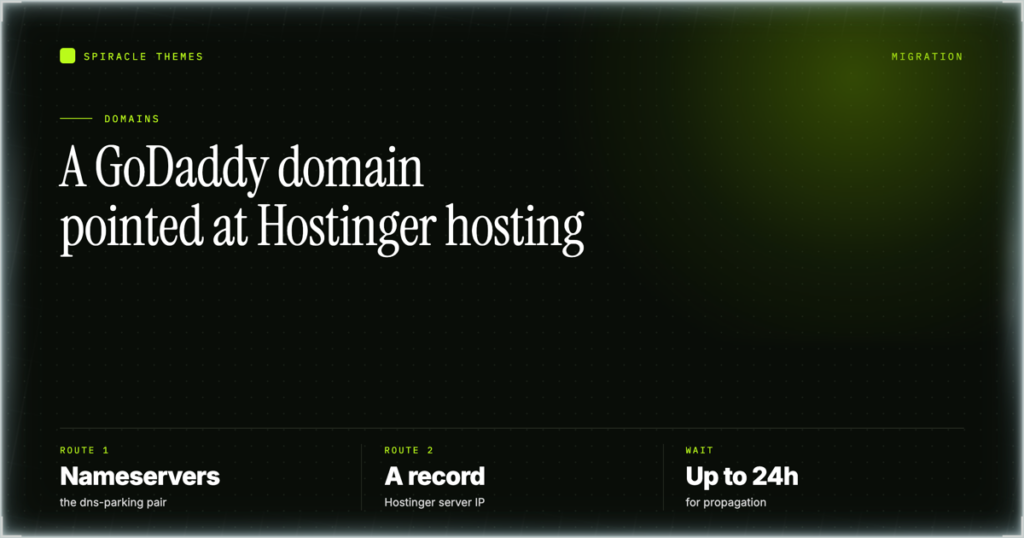
You can use a GoDaddy domain with Hostinger hosting in two ways. The recommended one is to change the domain’s nameservers at GoDaddy to Hostinger’s dns-parking pair, which puts the whole zone under Hostinger and makes the site, mail and subdomains work at once. The alternative is to leave the DNS at GoDaddy and add two records there, an A record for the domain and a CNAME for www, which keeps everything else, including email, exactly where it is. Both work. They fail in different ways, and the difference matters most if your email currently lives at GoDaddy.
Route A: point GoDaddy’s nameservers at Hostinger
This is the route to take when you want Hostinger to manage DNS for the domain. One switch moves the zone, and after it lands you never have to log into GoDaddy again for DNS.
On the Hostinger side first. Add the domain to your hosting plan, then read the exact nameservers Hostinger wants for that site. The values are shown in the plan details for shared, cloud and Agency hosting, and in the DNS Manager for a VPS. Do not copy them from an article, because Hostinger states the values differ by hosting type and domain; the dashboard is the authority. The nameserver guide lists every place the pair appears, by plan type.
- Sign in at GoDaddy and open the domain you want to point.
- Find the nameserver settings for that domain. GoDaddy has moved this around over the years, so look for the DNS or nameservers section rather than a fixed menu path.
- Switch from GoDaddy’s default nameservers to custom ones.
- Replace the existing entries with the two Hostinger values, normally
ns1.dns-parking.comandns2.dns-parking.com. - Save. GoDaddy may send a confirmation email, and the change may take a short while to appear on their side.
- Wait for propagation, which Hostinger documents as up to 24 hours.
Do not leave GoDaddy’s own nameservers in the list beside the new pair. A registrar that keeps both will keep answering from its own zone for some records, and you get a domain that half works in a way that is very hard to diagnose. Replace, do not append.
Sort the hosting out first: see the current Hostinger hosting plans — Premium is $1.99/mo on a 48-month term ($95.52 up front, renews at $10.99/mo), and every hosting plan carries a 30-day money-back guarantee.
Route B: keep GoDaddy’s DNS and add two records
If the domain’s email is at GoDaddy, or if someone else manages the DNS and you would rather not move it, keep the nameservers where they are and add only what the website needs. That is two records.
| Type | Name | Value | Why |
|---|---|---|---|
| A | @ |
<your Hostinger server IP> |
Sends the bare domain to the Hostinger server. |
| CNAME | www |
@ or your domain name |
Makes the www version resolve too, instead of showing an error. |
Two things to watch. First, if GoDaddy already has an A record on @ pointing at a parked page or an old host, edit that row rather than adding a second one, because two A records on the same name means traffic goes to whichever the resolver returns. Second, the CNAME target must be a hostname, not an address and not a URL with https:// in front of it.
Route B leaves every other record at GoDaddy untouched, which is the point. MX rows, SPF, DKIM, verification TXT values and any subdomain rows stay exactly as they were. If you later want Hostinger to manage mail records too, that is the moment to reconsider Route A.
Which route fits your situation
| Situation | Route | Reason |
|---|---|---|
| Email is at GoDaddy and you want it to stay there | B | MX rows are never touched, so mail does not move. |
| Email is at Hostinger, or you want it there | A | The whole zone moves, so mail records can be created in one place. |
| You want Hostinger to manage everything | A | One zone, one dashboard, no split ownership. |
| A developer or agency manages DNS at GoDaddy | B | You add two rows and leave their zone intact. |
| You need subdomains on Hostinger | A | Subdomain rows are simpler to manage in the zone that serves the site. |
| You are unsure where mail is handled | B first | Adds the site without changing anything that already works. |
Route A is the cleaner end state and the one most people want after a year. Route B is the safer first step, and it is reversible in one edit if you later decide to move the zone. Neither is wrong; picking the wrong one for your mail setup is what causes the outage. If you are still weighing whether the hosting itself is the right fit, the Hostinger review works through the plans and what each tier includes on the published data checked 10 November 2026.
What breaks, and how to avoid it
Email. This is the failure that matters. On Route A, the moment the new delegation takes effect, GoDaddy’s MX rows stop being read. If mail should keep arriving at the old provider, recreate the MX, SPF and DKIM values in Hostinger’s zone before you switch nameservers, or stay on Route B. There is no grace period and no warning; senders simply follow the new authoritative zone.
Subdomains. On Route B, any subdomain you create on the Hostinger side does nothing until someone adds a matching record at GoDaddy. A subdomain that worked yesterday can appear broken today purely because the zone that serves it never heard about it. On Route A this goes away, but remember that Hostinger domains do not allow custom NS records for subdomains, so a subdomain is always an A, CNAME or TXT row rather than its own delegation.
DNSSEC. If GoDaddy has DNSSEC enabled for the domain, turn it off before changing nameservers. A signed zone whose delegation no longer matches fails to resolve, and the symptom looks like a dead domain rather than a configuration mistake. Turn it back on at the new provider only once the zone is settled.
Other GoDaddy services. A parked page, a GoDaddy website builder site or a forwarding rule attached to the domain all rely on GoDaddy’s DNS. Route A removes them. If any of them should keep working, note the values before the switch.
SSL after the DNS resolves
A certificate can only be issued for a domain that resolves to the server asking for it. Until the A record or the delegation points at Hostinger, the certificate request has nothing to validate against, which is why SSL installs fail during a migration and then succeed on their own a day later. Hostinger includes free SSL with its hosting plans, and the SSL tab on the domain’s DNS page shows the certificate state for the domain and its subdomains.
Practical order of operations: move DNS, wait for propagation, then check SSL. Doing it in the other order produces an error message that says nothing useful about the real cause. If you need to add or correct a row after the switch, the hPanel DNS editor walkthrough covers the field-by-field steps, and Hostinger’s own reference material sits at support.hostinger.com.
Checking that the switch landed
Look up the domain with a public DNS tool from more than one location and compare what comes back to what you set. If the A record shows the Hostinger address in one place and the old address in another, the change is mid-propagation and there is nothing to fix. If it shows the old address everywhere after a day, the registrar did not save it.
Two checks worth doing in the same session: confirm www resolves as well as the bare domain, and confirm mail still arrives by sending a test message from an outside account. Both are cheap and both catch the mistakes that Route A and Route B actually produce.
Ready to connect the domain? check the Hostinger plans and current pricing — a plan with a free domain for the first year skips the registrar step entirely, and the 30-day money-back guarantee covers the hosting if the migration does not go the way you expected.
Frequently asked questions
Do I have to transfer the domain to Hostinger?
No. Changing nameservers is not a transfer. The domain stays registered at GoDaddy, you keep paying GoDaddy for it, and Hostinger only serves its DNS and hosts the site. A transfer moves the registration itself and is a separate decision.
Will changing nameservers at GoDaddy cancel my GoDaddy email?
It does not cancel the mailbox, but it does stop the domain pointing at GoDaddy’s mail servers unless you recreate the MX records in the new zone. If mail must keep working without interruption, keep the DNS at GoDaddy and add only the A and CNAME records for the site.
How long until the site loads from Hostinger?
Anywhere up to 24 hours, which is the propagation window Hostinger documents. The registrar’s own records often update faster than that, but resolvers holding a cached answer will keep serving the old one until it expires. Check from two locations rather than one before you assume the change failed.
Can I use Hostinger’s DNS while keeping GoDaddy as the registrar?
Yes, and it is the normal arrangement. The registrar holds the delegation and the hosting provider serves the zone, so the two jobs never have to sit in the same company. You point the nameservers at the dns-parking pair and GoDaddy stays the place you renew and pay for the domain.
Why did my site work but email stop after the move?
Because the zone moved and the mail records did not. The new zone had an A record for the website and no MX rows for the mailboxes, so senders had nowhere to deliver. Add the MX, SPF and DKIM values from the old provider to Hostinger’s DNS editor and delivery resumes once the change propagates.
The domain and the hosting are two separate things, and this migration only moves the second one. Decide where email should live before you touch the nameservers, write down the records you are about to leave behind, and give the change a day before you judge it. The rest is a registrar form and a wait.
